
ADHD & IDENTITY
ARE YOU YOUR DIAGNOSIS?
When an explanation becomes an identity. ADHD, labels and the person behind them.
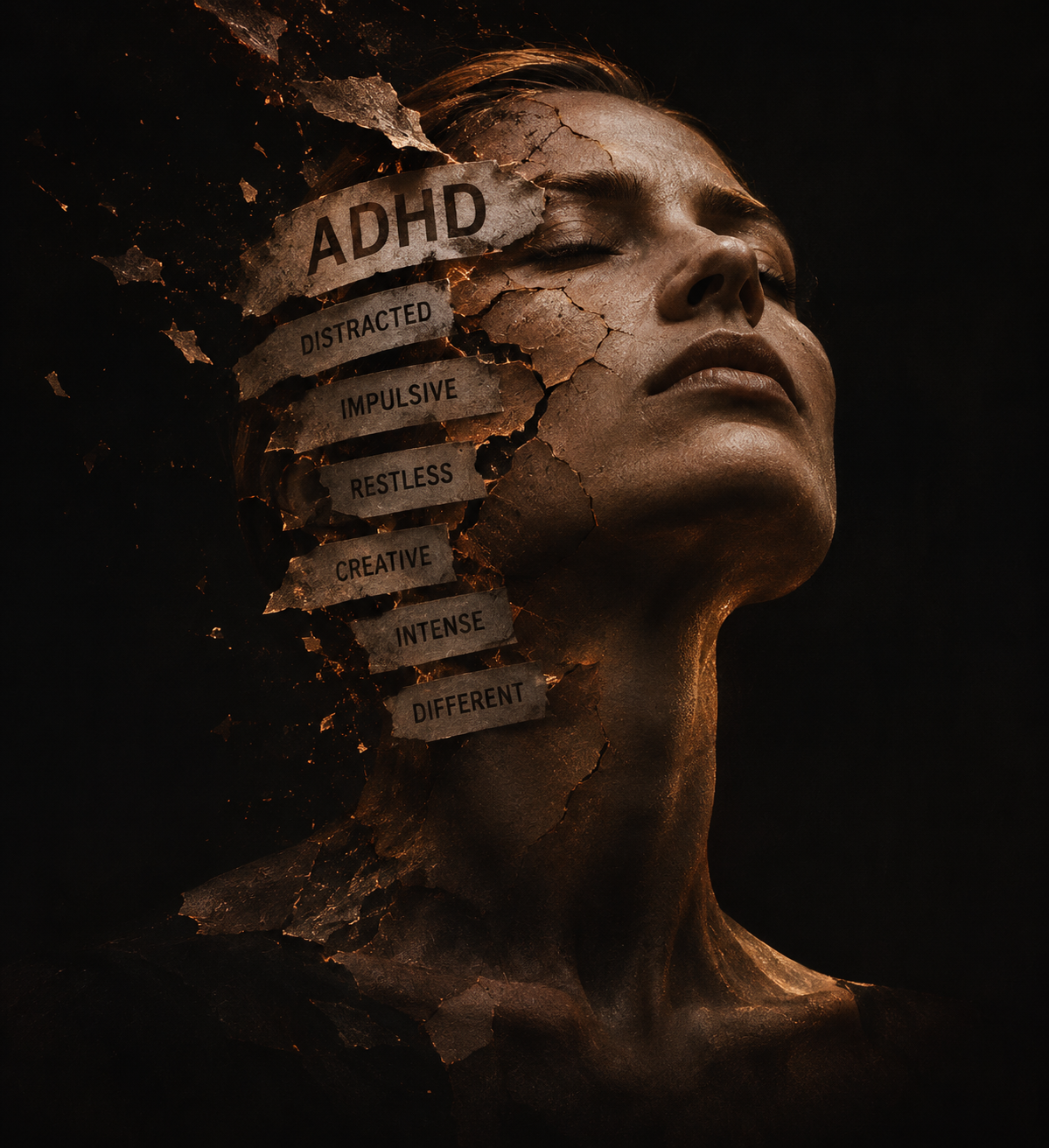
There is something profoundly human about wanting an explanation.
Why can’t I concentrate? Why do I struggle with things that seem effortless to others? Why does my mind never seem to slow down?
For some, an ADHD diagnosis finally provides an answer.
Years of confusion suddenly make sense. Behaviours once interpreted as laziness, carelessness or a lack of discipline acquire a different meaning.
And that can be liberating.
But there is another question worth asking.
At what point does an explanation become an identity?
THE STORIES WE TELL OURSELVES
The human brain is constantly trying to make sense of the world.
We organise our experiences into patterns. We create narratives about who we are, what we are capable of and why we behave the way we do.
Over time, these narratives become familiar.
Eventually, we may stop questioning them.
“I’m just an anxious person.”
“I’ve always been terrible at relationships.”
“I can’t help it. That’s my ADHD.”
Some of these statements may describe genuine difficulties. But descriptions can quietly become boundaries.
And boundaries, once accepted, can influence what we attempt, what we avoid and what we believe is possible.
THE DIAGNOSIS IS REAL. BUT IS IT THE WHOLE STORY?
ADHD is a recognised neurodevelopmental condition with substantial scientific evidence behind it.
For many people, diagnosis, medication and appropriate support make an enormous difference.
Questioning the relationship between diagnosis and identity does not mean questioning the legitimacy of the condition.
It means recognising something else.
A diagnosis describes a pattern of difficulties. It does not describe the entirety of a human being.
Two people with ADHD may share diagnostic characteristics while experiencing profoundly different lives.
Their environments differ.
Their relationships differ.
Their histories, fears, habits, opportunities and ways of responding to the world differ.
Even within the same individual, functioning can vary considerably depending on sleep, stress, interest, structure and circumstances.
A diagnosis may help explain certain patterns.
But it cannot tell the complete story of the person experiencing them.
ONE SIZE FITS NONE
Modern medicine depends on categories.
Categories help researchers identify patterns, clinicians make decisions and patients access treatment.
They are useful.
But categories also have limitations.
Research often tells us what happens on average across groups of people.
Yet the person sitting in front of us is not an average.
They are an individual.
What helps one person may do little for another.
What creates difficulties in one environment may be less problematic in another.
And what appears to be a fixed characteristic may sometimes be influenced by circumstances we have not yet understood.
This is not an argument against diagnosis or treatment.
It is an argument for curiosity beyond them.
Instead of asking only:
“How does someone with ADHD function?”
Perhaps we should also ask:
“How does this particular human being function?”
WHEN THE LABEL BECOMES THE LENS
There is a subtle danger in any explanation that becomes too complete.
Once we believe we understand why something happens, we may stop looking for other contributing factors.
A difficult morning becomes ADHD.
A failed relationship becomes ADHD.
An unfinished project becomes ADHD.
Sometimes ADHD may indeed be relevant.
Sometimes other factors matter too.
The point is not to dismiss the diagnosis.
The point is to remain curious.
Because understanding ourselves requires more than finding the right label.
It requires observing what actually happens in our lives.
Noticing patterns.
Questioning assumptions.
Testing possibilities.
And being willing to discover that some of our explanations are incomplete.
BEYOND THE LABEL
Imagine approaching your own behaviour without immediately trying to explain it.
Instead of saying, “I can’t concentrate because I have ADHD,” you might ask:
“When do I find it easier to concentrate?”
Instead of “I’m terrible at maintaining relationships”:
“What happens in my relationships when I feel overwhelmed?”
Instead of “This is simply how my brain works”:
“What conditions seem to help me function better?”
These questions do not erase neurological differences.
They create room to understand how those differences interact with a particular life.
And sometimes that understanding can reveal possibilities that a diagnosis alone cannot.
THE QUESTION THAT REMAINS
Perhaps the greatest illusion is not believing that we have a condition.
Perhaps it is believing that any single explanation can tell us everything about who we are.
You may have ADHD.
You may benefit enormously from medication, structure, therapy or other forms of support.
You may also discover patterns, capabilities and possibilities that no diagnostic manual could ever fully describe.
Because you are not simply a collection of symptoms.
You are a human being whose story is still unfolding.
And perhaps the most interesting question is not:
“What diagnosis explains who I am?”
But:
“Who might I become if I stopped treating every explanation as a conclusion?”
This perspective explores identity and self-understanding. It is not intended to replace medical assessment or treatment.
All perspectives →